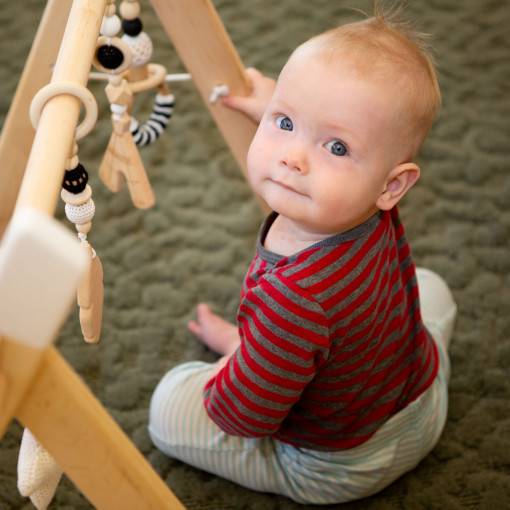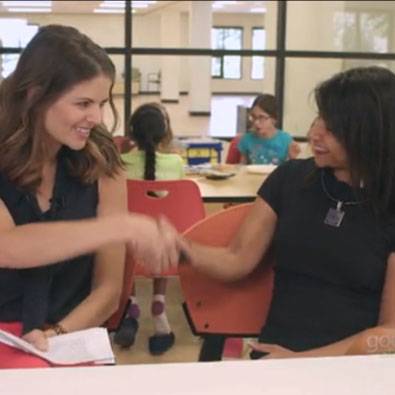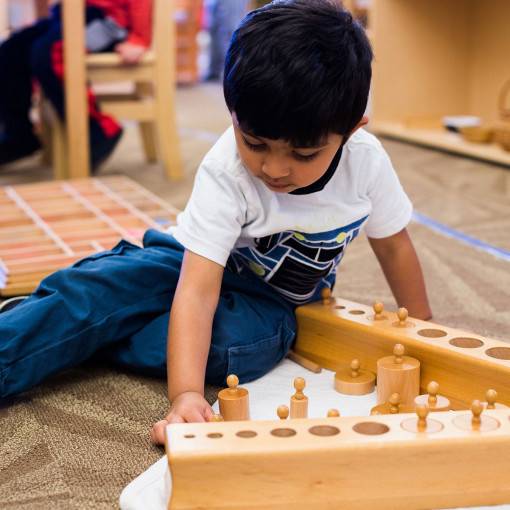
The Montessori curriculum is international in its focus and seeks to promote a global perspective. It is academically rich and challenging. It is an integrated, thematic approach that ties the separate disciplines together into studies of the physical universe, the world of nature, and the human experience. In this way, one lesson leads to many others. It provides hands-on materials to clearly demonstrate abstract concepts in a concrete manner so children become confident in their understanding. All aspects of the curriculum are integrated into a meaningful whole. They include:
PRACTICAL LIFE:
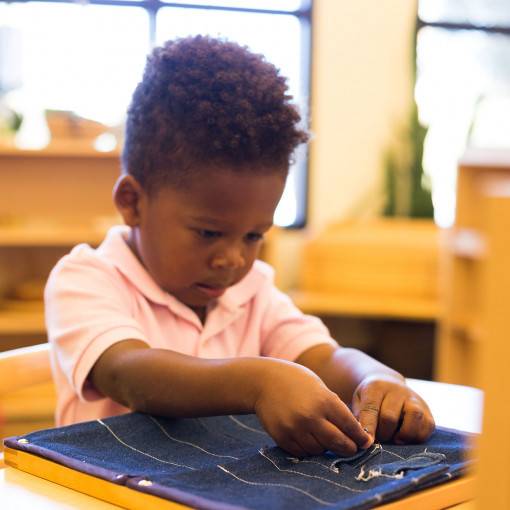
This area is designed to invite children to act and work on real life tasks that foster independence, coordination, order and concentration. It is the “doorway to the Montessori Curriculum.” The Practical Life area contains variety of items commonly used in the tasks of daily living, like eating, dressing, and cleaning. The materials are also designed to help teach skills involved with caring for the environment and the self, to encourage responsibility and promote high self-esteem. Children gain independence by mastering practical life exercises.
SENSORIAL:
Senses are the “doorway to the mind.” Sensory and manipulation aid to the development of maturing sense organs (eyes, ears, nose, tongue, and skin). They are also the starting point for the intellectual growth. The basis sensorial exercise inspires careful observation and attention to specific qualities requiring identification of similarities and contrasts. Each sensorial materials isolates one defining quality such as colors, shape, sizes, sounds, textures, and scents. Children are better prepared for future learning in math, language, and science by mastering sensorial exercises.
MATHEMATICS:
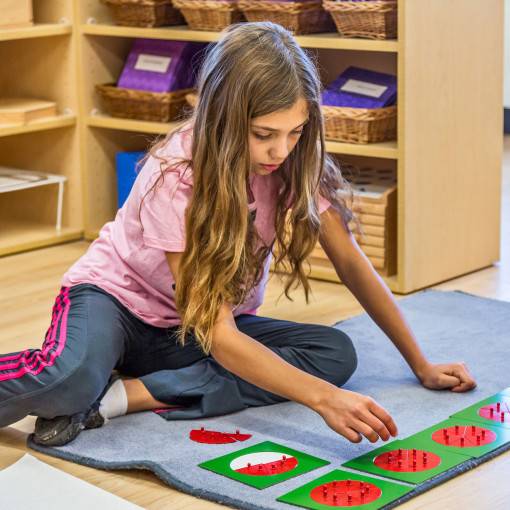
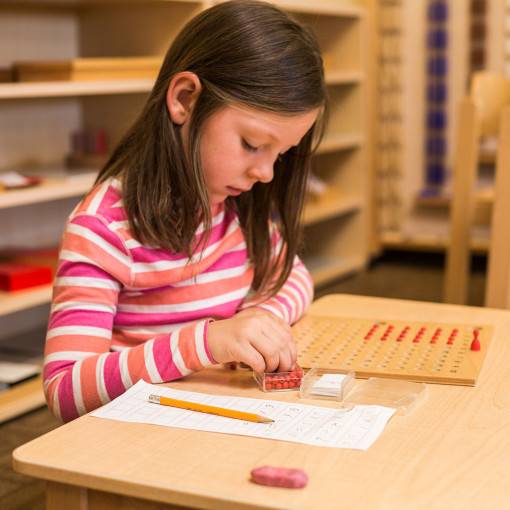
The central purpose of the Math materials in the early years is to lay the foundation for later cognitive development and to prepare for the gradual transition to abstract thinking. Montessori curriculum uses hands-on learning materials that make abstract concepts clear and concrete. Children will learn to recognize numerals, counting sets for numerals, addition, subtraction, skip counting, multiplication, division, measuring, and fractions.
LANGUAGE:
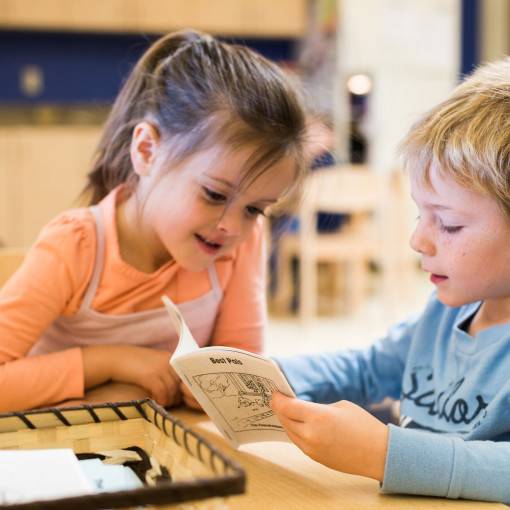
Language development activities foster vocabulary development, communication skills, writing and reading readiness. Language area includes variety of reading materials, phonetic analysis, word skills and reading, as well as materials for the refinement of motor control for writing. Writing proceeds reading in the Montessori Method, as the children explore with drawing and forming letters. The child begins by exploring the sounds that compose words and by relating them to the letters of the alphabet.
Pre-writing skills include preparation of the muscles to hold a pencil, trace outlines and to control the pressure when using a pencil. Reading skills include the use of sandpaper letters, letter sounds, pictures, blends and digraphs, and long and short vowel patterns.
SCIENCES, GEOGRAPHY, AND THE ARTS:
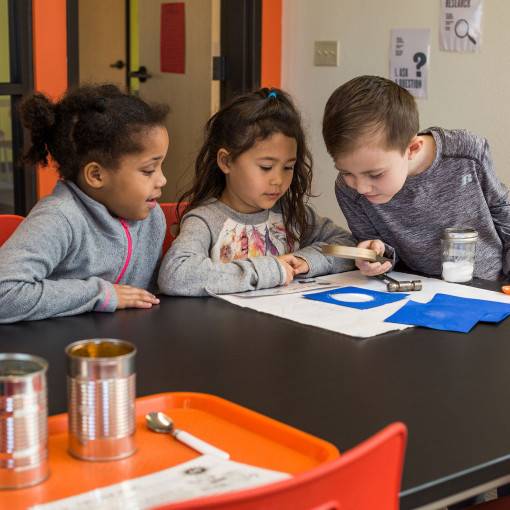
Science is the integral element of the Montessori curriculum. It represents a way of life: a clear thinking approach to gathering information and problem solving. It includes botany, zoology, chemistry, physics, geology and astronomy. History and Geography begins with maps and names of continents and countries and moving on to world’s cultures.
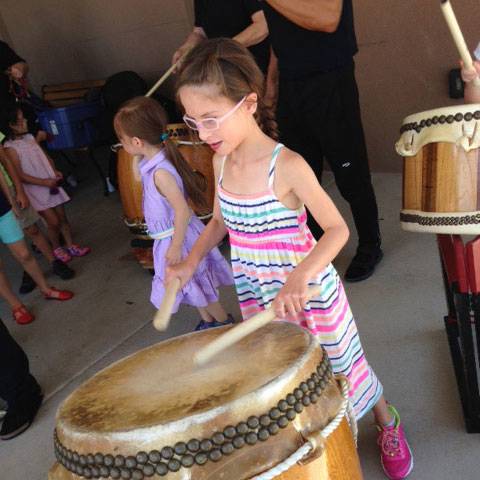
Music and Arts will offer children ways to express themselves, their feelings, and ideas while developing their fine and gross-motor skills.
Contact Montessori ONE Preschool Academy @ Phone: 505.822.5150 | Email:
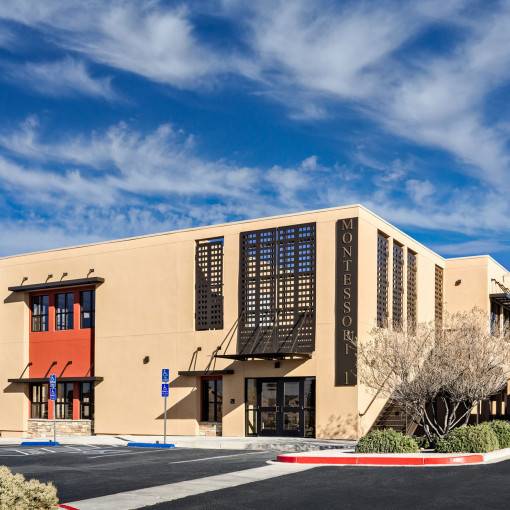
director@montessoriONE.net | Location: 9360 Holly Avenue, NE | Albuquerque, New Mexico 87122
Copyright © Montessori ONE Preschool Academy. All Rights Reserved.